Grafik (50 Werke)
Graphics (50 works)
Michael Maschka
13
Grafik (50 Werke)
Graphics (50 works)
Michael Maschka
Material
Graphics
Dimensions
—
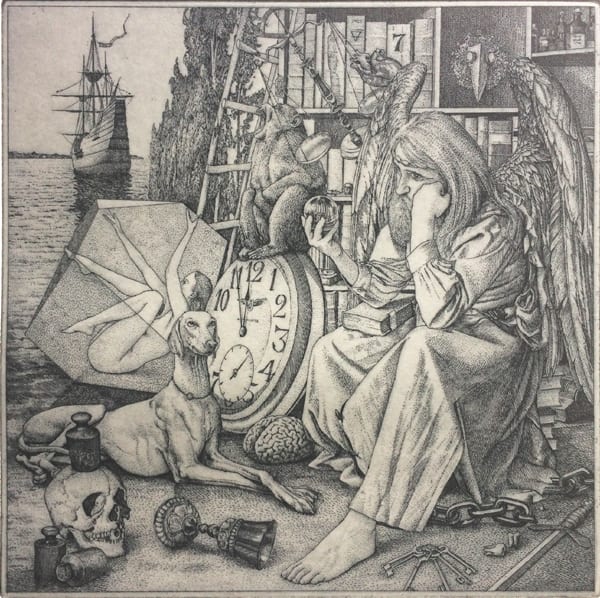
“The only truly real, uniform line is the etched one. Finely drawn it offers incomparable grace, unsurpassable sweep. Broadly etched, it acquires the character of a monumental grandeur, a serious weight to which nothing else comes close. The etched line is the line par excellence, and etching is the ideal of black-and-white art” (quoted from H. W. Singer, "The Handbook for Copperplate Engraving Collectors", from the year 1922). Etching is a technique that, like engraving, has its origins in the goldsmith workshops of the 15th century. It represents a further development of engraving, which had served gold- and silversmiths since antiquity for the ornamentation of jewelry, vessels and weapons. At that time, the lines engraved with the burin were filled with “niello” (black enamel). To make the drawing visible and to obtain a pattern template for later works, an impression on paper was taken before the fusion. The first copper engravers were therefore goldsmiths. It was the goldsmith Tommaso Finiguerra who, in the mid-15th century, initiated the practice of making the first copperplate impressions using the niello technique. The first dated print, “Geißelung Christi”, dates from 1446. All the tools of the engravers (burin, punch, scraper, burnisher) originate from the goldsmith’s workshop. In the 15th century the copperplate was used above all as reproductive graphic art, which enabled the dissemination of works by great masters. Mantegna, Dürer and Schongauer were among the first to bring this technique to the highest perfection. Dürer, who initially learned the goldsmith’s trade from his father, was also the one who undertook the first experiments in producing etchings. The use of acid had until then been customary mainly among armorers. The first dated iron etching is from 1513, by the Swiss copper engraver Urs Graf. Etching had the advantage of bypassing the lengthy and arduous work with the burin and thus enabling a freer, more spontaneous manner of working. In this process the color-bearing recesses are etched into the metal plate by the acid. Before the artist begins the drawing with a fine needle, the iron, copper or zinc plates must be coated with an acid-resistant varnish. Engraving and etching are often applied on the same plate, the burin work frequently serving as a means of correction. The Nördlingen artist Michael Maschka consciously links to this long and rich tradition of the art of etching and employs this technique in an old-masterly manner. Etching, which is often confused with other reproductive processes, is pure handwork from the making of the drawing to the finished print. Since each sheet shows slight deviations as a result of the handcrafted process and thus becomes a unique piece, it is entirely correct to speak of an “original graphic.” Maschka is one of the few artists who do not work with professional printers but prints each sheet himself. The content of Michael Maschka’s works is initially characterized by a preference for themes from the realm of religious and ancient mythology. Myth, as the sensual image of a supersensory world, is a central motif in his work. Maschka retells the old myths of the Greeks, Romans and Germanic peoples in his pictures and sculptures and thereby reveals unexpected layers of meaning to the viewer. In his works he traces, with an expressive formal language and great attention to detail, the bizarre inventive power of the soul. The artist’s concern is not the depiction of reality visible to all, but the hidden worlds of dream and soul. Further information about the artist is available on the internet at www.MichaelMaschka.de