Comedy of Love
Michael Maschka · 2014
06
Comedy of Love
Michael Maschka · 2014
Material
Oil on canvas
Dimensions
100 × 120 cm
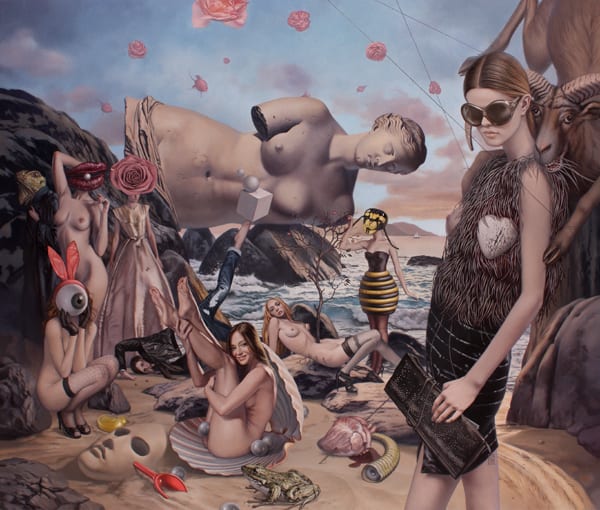
The painting depicts a beach scene that appears surreal, with many unusual and symbolic elements. In the foreground a naked woman sits on a shell, smiling as she gives birth to pearls, while various objects lie around her — among them a frog, a pierced heart, a mask and assorted sandbox toys. To the right stands a fashionably dressed woman wearing sunglasses and a dark, fur‑like dress, who casts a distant glance at the viewer. Behind her is a goat or horned animal that appears almost like a companion figure. In the background lies a huge Venus sculpture resting on rocks, as if weightless or dreamily removed.
Other female figures appear in partly theatrical, partly estranged poses: one wears a dress of flowers, another has a bee’s body, and another seems to be holding a mask or an oversized eye. Rose petals float through the air, and the sea in the background appears calm, almost unreal in the evening light. The entire scene plays with the visual language of Surrealism: reality and dream intermingle, proportions are distorted, meanings remain open.
The painting is an engagement with themes such as identity, femininity and their perception. The many different female figures represent various roles or facets of the self — sensuality, vulnerability, masking, transformation. The torso of the Venus de Milo lying in the sea evokes an idealized notion of love which, in its purity, increasingly sinks in the tumult of real, existing love and life. The goat is often associated in art with instinctual drives, nature or even the demonic. Roses classically signify love, beauty but also transience. The sea in the background could represent freedom or the unconscious.
Overall the picture reads like a dream landscape that thematizes inner conflicts, desire, social role models and the interplay between naturalness and staging. It leaves room for the viewer to interpret and invites them to consider the individual symbols for themselves.