Der Wanderer
The Wanderer
Michael Maschka · 2025
02
Der Wanderer
The Wanderer
Michael Maschka · 2025
Material
Oil on canvas
Dimensions
40 × 40 cm
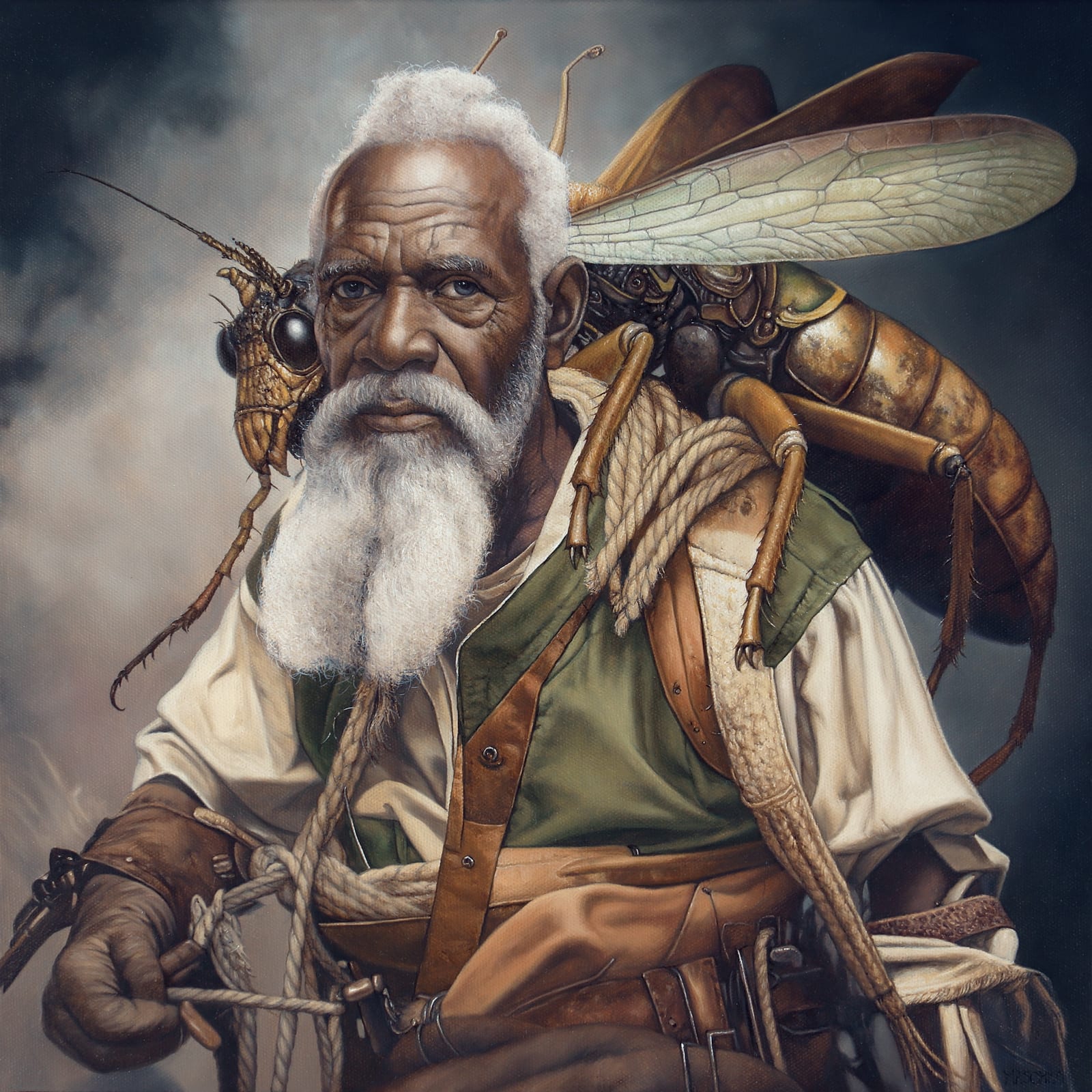
The painting shows the portrait of an old man who appears like a traveler or adventurer. His face is shaped by deep wrinkles, his gaze serious and alert. He has a long white beard and white hair, which point to advanced age and much life experience. His clothing suggests a mixture of traveler, craftsman, and explorer equipment: leather straps, belts, pouches and robust fabrics that look practical, as if he has been on the road for a long time. The most striking element, however, is behind him: a large, insect-like creature—evoking a bee or wasp—sits on or is connected to his gear. Its wings are transparent and finely structured, while the body appears partly as a blend of nature and mechanism. The insect does not seem aggressive, but rather like a companion or part of his equipment. The background is dark and cloudy, almost misty. As a result, the figure stands out very strongly and appears almost iconic—like a mythical figure.
Meaning: A figure approaches us from afar: old, experienced, marked by long roads. The Wanderer carries his equipment like a life on his shoulders—traces of travel, work and memory. Yet on his back sits something alien. The large, hybrid insect is neither clearly natural nor familiar. It seems to have attached itself to the Wanderer’s body—a companion, perhaps also a parasite. Its origin remains unclear. It could be a being that spreads in the shadow of movement, carried by the mobility of the world. The Wanderer himself seems hardly to notice this appendage. His gaze is directed forward, to the next step. Wandering has always been part of human history—it is the search for life, shelter, hope. But with every movement through spaces and cultures not only people and stories are carried forward, but also conflicts, imprints and invisible burdens. The insect can be understood as a metaphor for such accompanying elements: for influences that latch onto movements and reach new spaces without their bearer consciously guiding them. The Wanderer thus appears neither as a hero nor as a threat. He is rather a figure of ambivalence: someone on the move—and in doing so transporting more than he perhaps himself realizes. The painting offers no answers. It asks: What do we carry with us when we set out? And what enters the world through us?